
Doctors in Secondary Schools
The Doctors in Secondary Schools program provides school-based health services to 100 Victorian secondary schools considered most in need. It complements existing student-wellbeing programs.
On this page:
Program overview
The Doctors in Secondary Schools program has been running since 2017 and there are 12 participating schools in the EMPHN region. The funding provides students with access to no-cost healthcare in purpose-built facilities located at the school.
A GP and a Practice Nurse (PN) attend the school once a week. GPs, PNs and Primary Care Service Providers are paid and supported to participate in the program.
The core objectives of the program are to:
- Make primary health care more accessible to students
- Provide assistance to young people to identify and address health problems early
- Reduce pressure on working families
Program impact
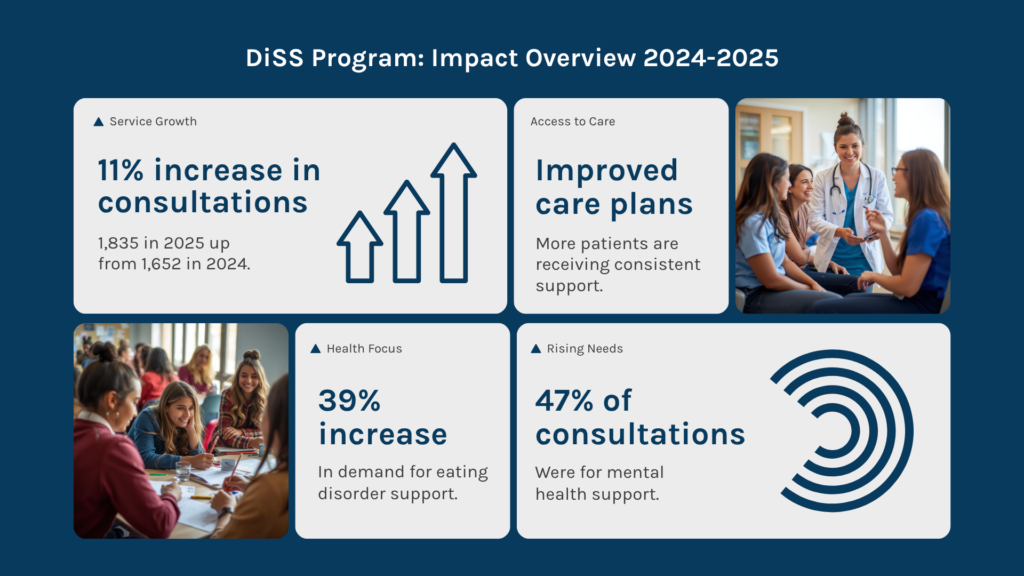
The snapshot below highlights the program’s impact over 2024-2025.
“As a new doctor to DiSS, I am so happy to say that the service provides young people with the time and space to talk. There is no rush, and the students sense that. With one particular Year 8, we sat and chatted about all things… And finally, an hour later, the real reason behind the behaviour came out. That is the crux of mental health – time, support and a listening ear.”
Dr Libby Rochstein, GP, Yarra Hills Secondary College
“There was a student who was very grateful for all the support and kindness she received through her time with the DiSS clinic. She had accessed the DiSS clinic for around a year for bullying, low self-esteem, eating disorder and had a mental health care plan.”
Jo Morkham, PN, Manningham General Practice
Read more testimonials from health professionals, students and teachers about the program’s impact
“I first met this student when she was in Year 10 in 2019. She was terribly nervous and spent most of her time in wellbeing rather than attending class. She eventually linked in with DiSS and then spent most Tuesdays there with us enjoying a comfortable space, music and some food. She felt very comfortable and confident in using our service. Unfortunately, during lockdown, the wheels fell off – she left school abruptly and went to be with one of her parents in regional Victoria. Her life took a turn in a completely different direction – substance abuse, risk taking behaviour, unemployment, another abusive relationship and homelessness. Somehow, after all the turmoil and chaos, she managed to get herself safely admitted to Northern Hospital earlier this year. She successfully detoxed, worked very hard with the psych team to get a diagnosis and medication regime. She was transferred to Eastern Health Psych Services and moved back to the area. She has since re-engaged with our GP clinic, and I had the opportunity to see her yesterday. She openly shared with me her horrific experiences over the last 4 years and very clearly stated that there was no way she would have been able to take herself to hospital or see a doctor by herself if it had not been for her positive experience at the DiSS clinic. This young lady is now 22 years old. Whilst she still has a difficult journey ahead of her as she starts to heal and recover, she is actively engaging with psych services weekly, she is looking for a job, working towards getting her license and has made an appointment to see me again next week with the plan to present for review every week. I realise that not every aspect of this story is positive, however, I am encouraged by it, knowing seeds that were planted 6 years ago are finally bearing fruit as this young woman confidently re-engages in her health and recovery. Great work DiSS team!”
Claire, PN
“A student with severe substance use, depression, disordered eating and a history of relationship violence has gradually engaged with our DiSS program over the past 3 years. Gaining her trust has been a very gradual process and would not have been possible without the consistent presence of the DiSS program at school. With the support of school wellbeing staff and the DiSS clinic, she has been able to access inpatient detox treatment and ongoing drug and alcohol support, as well as effective contraception and sexual health care. She continues to see the DiSS clinic regularly for medical monitoring and mental health support, and thanks to the intensive support provided by the school wellbeing team she has managed to remain engaged with her education.”
DiSS GP
“The DiSS program is an asset to the school that enriches our school community. The program has allowed our school to offer a more comprehensive suite of care to our students, particularly at a time when cost of living is high. The ability to provide for bulk-billed medical appointments for students that is conveniently on-site at school means that students can engage both proactively and reactively for their health needs. In visiting our DiSS building recently to support a student in need, I was again blown away by the care and synergy that such an arrangement enables. The ability to support with key items facing our young people, including mental health and the provision of mental health care plans, means that some of the barriers that can exist for young people to access care are removed. This is, no doubt, a win for schools and for students that is much appreciated in our school.”
Matthew Lee, Principal, Melba College
“We recently initiated Implanon insertions onsite at DiSS in Wallan. After that success we had the patient’s friend come in to get the same. Word of mouth obviously spread.”
Dr Rebecca Brown, GP, Wallan Secondary College
“Through our DiSS program, we identified that 50% of student presentations were related to disordered eating. This data underscored the need for a targeted response. In recognition of this, eight members of our wellbeing team and staff have completed Body Project Facilitator Training and are now delivering proactive, small-group programs for students who choose to opt in. These sessions aim to reduce the stigma surrounding body image and societal appearance expectations.”
Tracey Smedley, Wellbeing Coordinator, Upper Yarra Secondary College
Participating schools
Eligibility
General practices/clinics
Primary Care Service Providers must be accredited against the Royal Australian College of General Practitioners (RACGP) Standards for General Practice. Practices that are accredited or registered for accreditation and committed to working with the school on an ongoing basis are encouraged to apply.
Primary Care Service Providers are required to provide bulk-billing services for students, have a medical software program and have – or are willing to have – a clinical audit tool installed to record and report data.
All clinicians will be required to undertake mandatory training in-line with program requirements.
General practitioners
The program requires GPs with:
- A medical degree with licence to practice in Australia
- Australian Health Practitioner Regulation Agency (AHPRA) registration with no restriction on scope of practice
- Appropriate Medical and Professional Indemnity Cover
- A satisfactory Working with Children Check
- A National Police Check
Practice nurses
The program requires PNs with:
- Australian Health Practitioner Regulation Agency (AHPRA) registration with no restriction on scope of practice
- A satisfactory Working with Children Check
- A National Police Check
Resources and information
Department of Education
UoM (webinars)
Consent and Confidentiality
Get involved
The Doctors in Secondary Schools is an ongoing program, funded by the Department of Education. Our goal is to ensure that the 12 participating schools in our region can consistently offer this service. If you are a GP, PN or Primary Care Service Provider interested in the Doctors in Secondary Schools program, complete the form below. We will contact those who have submitted an expression of interest before releasing vacancies to an open market.