11 August 2026
On this page:
EMPHN’s latest engagement with general practice and allied health providers has provided a valuable picture of what is working well, where pressures remain and how we can strengthen our support.
The engagement included 363 general practice survey responses and 243 allied health survey responses. This was followed by workshops with 23 general practice representatives and 47 allied health representatives, providing an opportunity to test the findings and explore the key themes in greater depth.
General practice survey respondents represented different parts of the practice workforce, with 37% identifying as practice managers, 35% as GPs and 25% as practice nurses. This breadth is important because each group experiences the health system differently and has distinct information, education and support needs.
Encouraging improvement since 2023
The results show improvement and opportunities in how general practice experiences EMPHN.
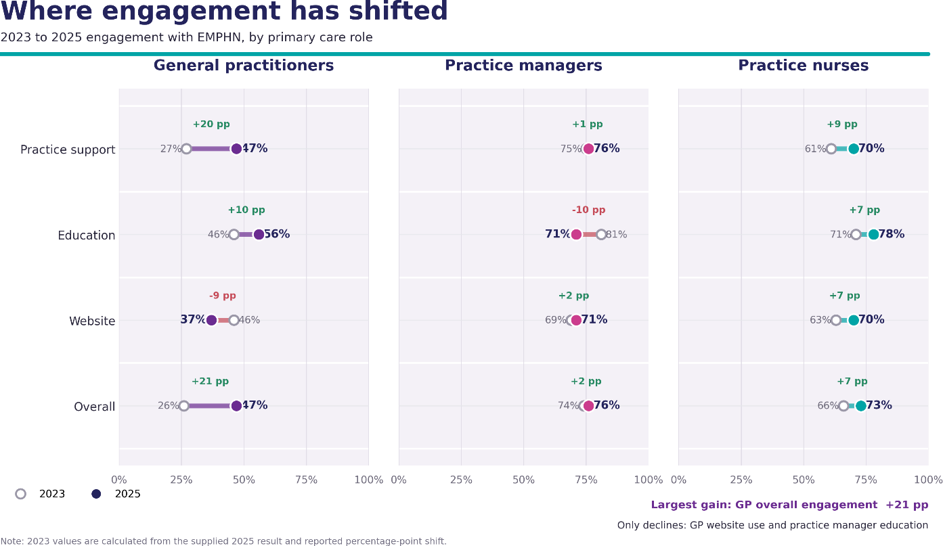
Among GPs, 47% now rate EMPHN’s overall performance as high or very high
Practice nurses reported improvement across all four performance measures, including a nine-point increase for practice support and seven-point increases for education, the website and overall performance. Practice managers continued to report high satisfaction, with 76% rating both practice support and EMPHN’s overall performance as high or very high.
These results suggest that EMPHN is building stronger recognition and engagement across the primary care workforce. Survey respondents and workshop participants particularly valued support that is accessible, responsive and directly connected to the needs of practices. Quality improvement, digital health and practice engagement were consistently identified as areas of strength.
Different roles have different needs
The findings also show why a whole-of-practice approach is essential.
Practice managers reported strong uptake of EMPHN’s quality improvement resources and valued practical support that helps them respond to policy, Medicare and operational changes. Practice nurses particularly valued training, resources and ready access to EMPHN staff. GPs wanted more direct relationships, locally relevant information and practical assistance with navigating services and system changes.
Awareness of existing resources was not consistent across all groups. Practice managers were often the main recipients and users of EMPHN materials, while some GPs were unaware of the support available or relied on other members of the practice team to access it. GP ratings of the EMPHN website also declined compared with 2023, highlighting an opportunity to make information easier to find and more relevant to clinical roles.
The implication is clear: effective practice support cannot rely on a single message, channel or format. Information and capability-building activities need to reflect the roles of GPs, practice nurses, practice managers, reception teams and administrative staff, as well as the different needs and circumstances of individual practices.
Strong interest in more connected care
There is considerable interest in multidisciplinary and team-based care. Approximately 80% of respondents expressed interest in extending their practice’s multidisciplinary care capabilities, while 74% reported already having allied health professionals employed by or located within their practice.
However, practices identified several barriers to making multidisciplinary care work consistently, including funding constraints, limited connections with suitable providers, fragmented systems and difficulties navigating referral pathways.
Allied health participants similarly described relationships with general practice as frequently informal or dependent on individual connections. They identified opportunities to improve the visibility of allied health services, clarify referral expectations and create more structured opportunities for general practice and allied health providers to work together.
These findings reinforce an important role for EMPHN as a local system connector. Practices are looking to EMPHN to build relationships between general practice, allied health, specialists, hospitals and commissioned services in ways that individual providers may not have the capacity to do alone.
Practical support for current pressures
The engagement also identified several priority areas where practices want additional support.
AI is already being used across general practice, particularly for administrative activities such as documentation and scribing. While attitudes were generally positive, familiarity varied and participants raised concerns about privacy, cost, governance and the accuracy of AI-generated information. This presents an opportunity for practical education and guidance that helps practices use AI safely while reducing administrative burden.
Aged care remains another significant pressure. The proportion of GPs reporting that they visit residential aged care homes declined from 58% in 2023 to approximately 50% in 2025. Respondents identified limited capacity, financial sustainability, workforce pressures and low telehealth uptake as barriers.
Practices also highlighted difficulties navigating mental health services and continuing concerns about communication between hospitals and general practice. Only 50% of GPs reported receiving urgent care discharge information within 24 to 48 hours, while hospital discharge reporting varied considerably. Timely and complete clinical information remains essential for continuity of care.
Turning feedback into action
Thank you to everyone who participated in the surveys and workshops. Your feedback has provided a clearer understanding of what general practices and allied health providers need from EMPHN, as well as how that support can be made more accessible, practical and relevant.
We will use these learning to inform the design feature of future initiatives that strengthen primary care across the region.
As this work progresses, we are exploring new opportunities to strengthen the supports, connections, partnerships and enablers that help primary care providers deliver high-quality, coordinated care. This includes considering how to better support quality improvement, multidisciplinary care and collaboration across the health system.
Future initiatives will be developed through ongoing consultation with general practices and allied health providers to ensure they respond to local needs, complement existing sector activities and support better outcomes for providers, consumers and the broader health system. While we undertake this future design, we will continue to deliver the support, capability building and services you said you valued the most.